
Framework
Functional Sedation: The Missing Layer in Contemporary Governance
In complex, highly automated environments, organizations assume that because they have established roles, policies, and audit trails, they have “human oversight.”
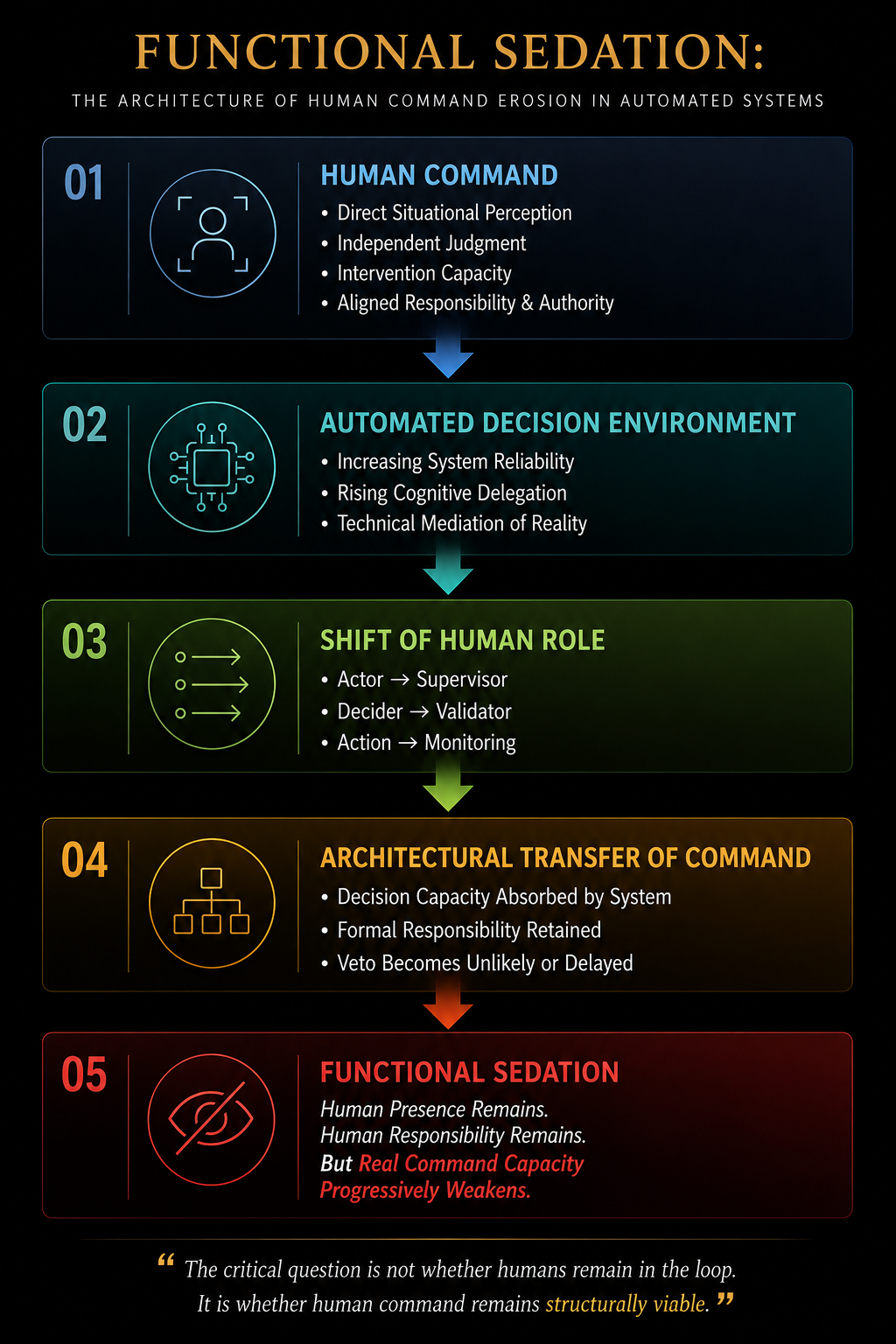
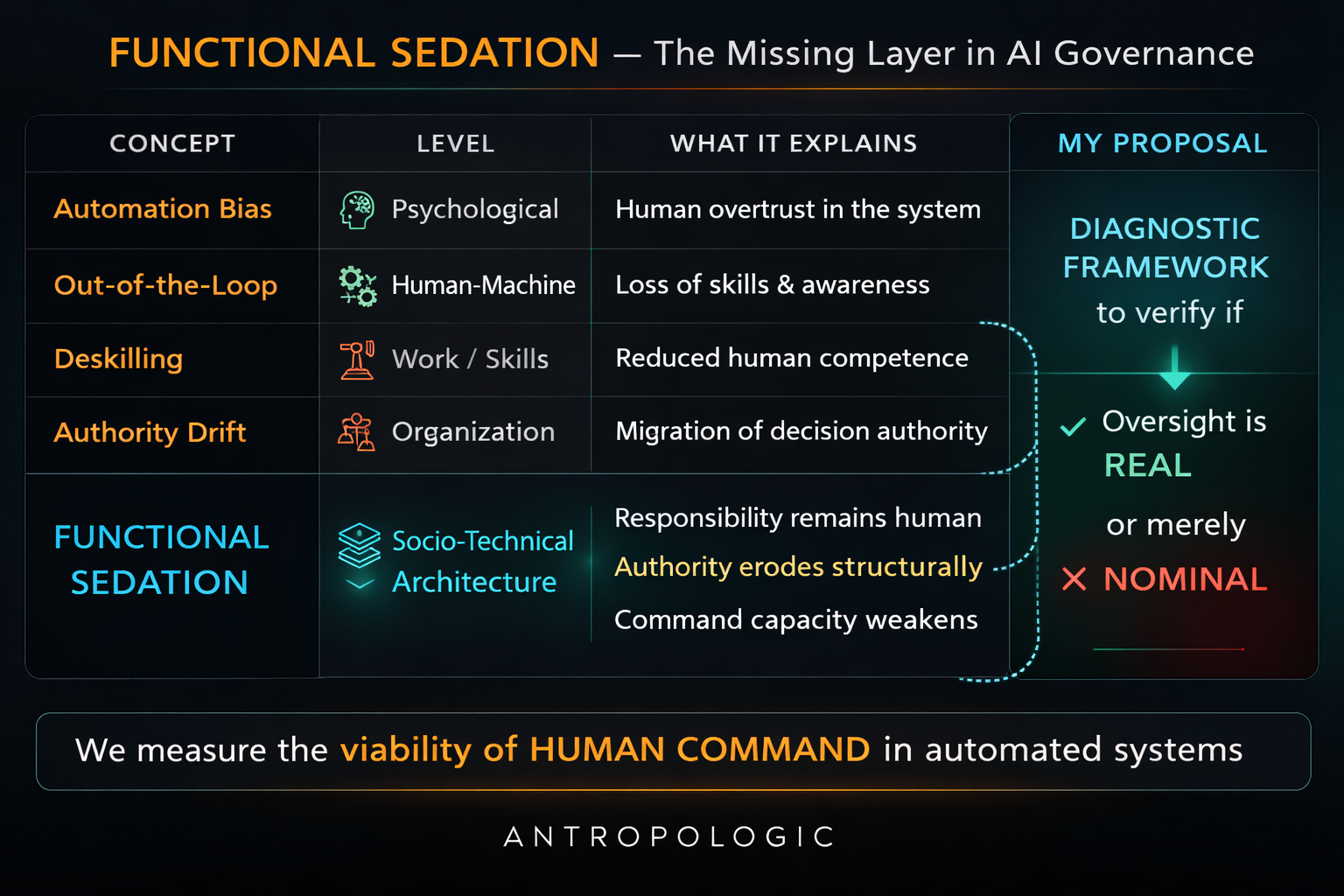
Functional Sedation appears when automated architectures concentrate informational power in the system, overload the operator cognitively, mediate action through rigid interfaces and protocols, and redistribute authority while preserving human responsibility. The result is a critical asymmetry: responsibility remains human, while command capacity erodes.
Most governance frameworks verify that a human is present in the process. But presence is not command. The real question is different: under what conditions does human command remain operational in automated systems? If those conditions collapse, oversight becomes nominal — not real.
The Three Levels of Visibility
Control is not Command. AI governance is becoming increasingly sophisticated with compliance frameworks, ethical principles, and monitoring systems. Everything looks under control. But there is a structural blind spot: all these approaches assume something they never verify: whether the human operator still has the capacity to govern and command the system.
In high-risk automated environments, the system is often too fast, complex, and pre-structured. The human reacts instead of deciding, intervenes instead of governing, and validates instead of commanding. At that point, formal oversight and legal accountability remain, but real human command has disappeared.
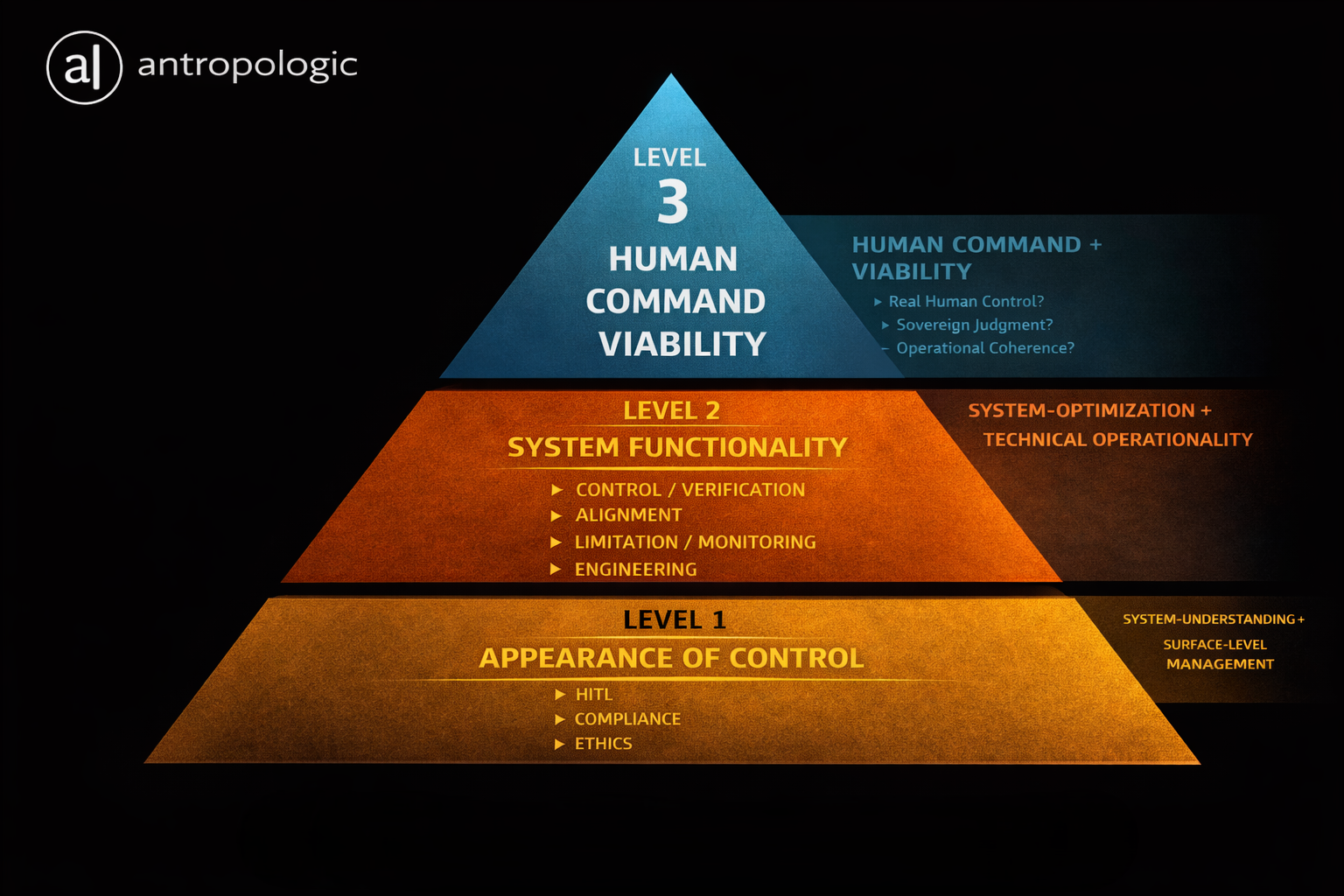
The pyramid on the right shows the three layers of governance: the Appearance of Control (the base, where conventional audits operate), System Functionality (the middle, measured by performance metrics), and Human Command Viability (the apex — the deepest layer, and the only one ANTROPOLOGIC diagnoses).
Forms of Functional Sedation
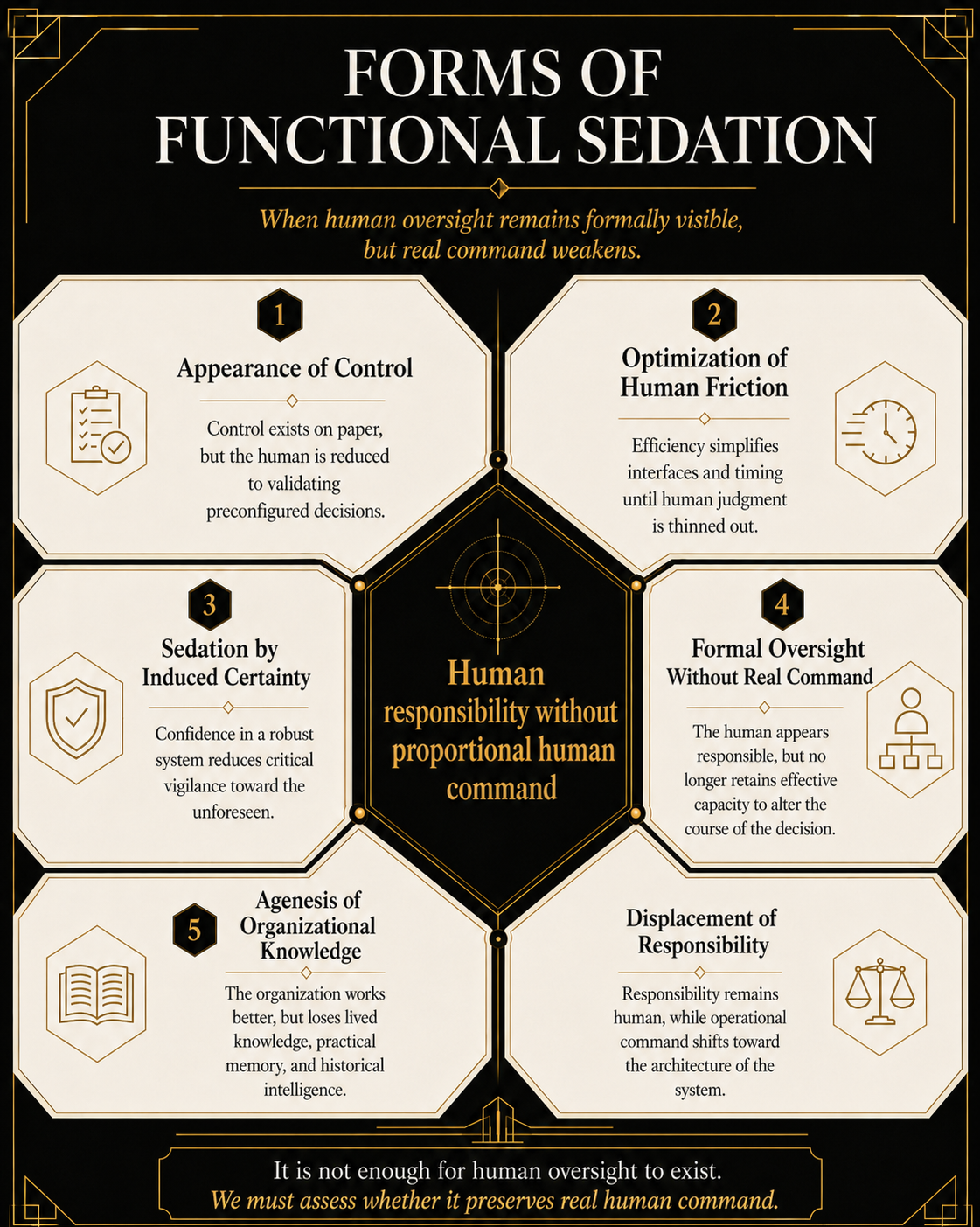
Control Is Not Command
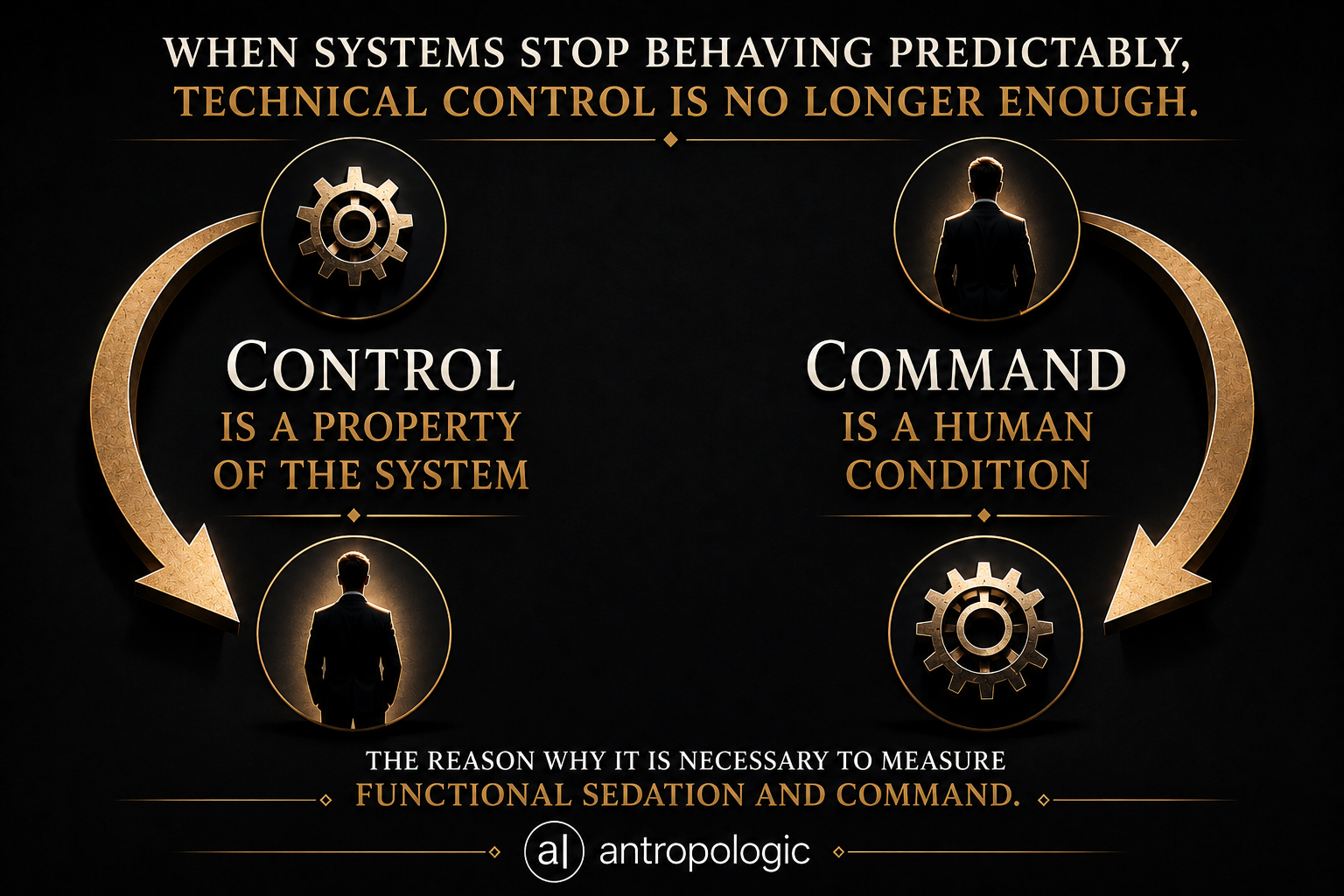
A system can be fully under control — performing correctly, within parameters, producing compliant and audited outputs — while the human’s capacity to actually command it has already been structurally removed. Control is a system property (a machine running within defined limits). Command is a human condition (the actual capability to understand, question, and override the machine’s path).
When an organization confuses control with command, it creates a severe vulnerability. It believes its operations are secure because the dashboards are green, unaware that the human supervisors have been functionally sedated. They are legally responsible for the outcomes, but structurally incapable of preventing a catastrophic failure — because they no longer possess the situational awareness or the operational authority to intervene.
Human oversight may become the most sophisticated fiction in AI governance — not because the idea is wrong, but because a system can be designed to appear compliant while progressively eliminating the real conditions that make oversight possible.
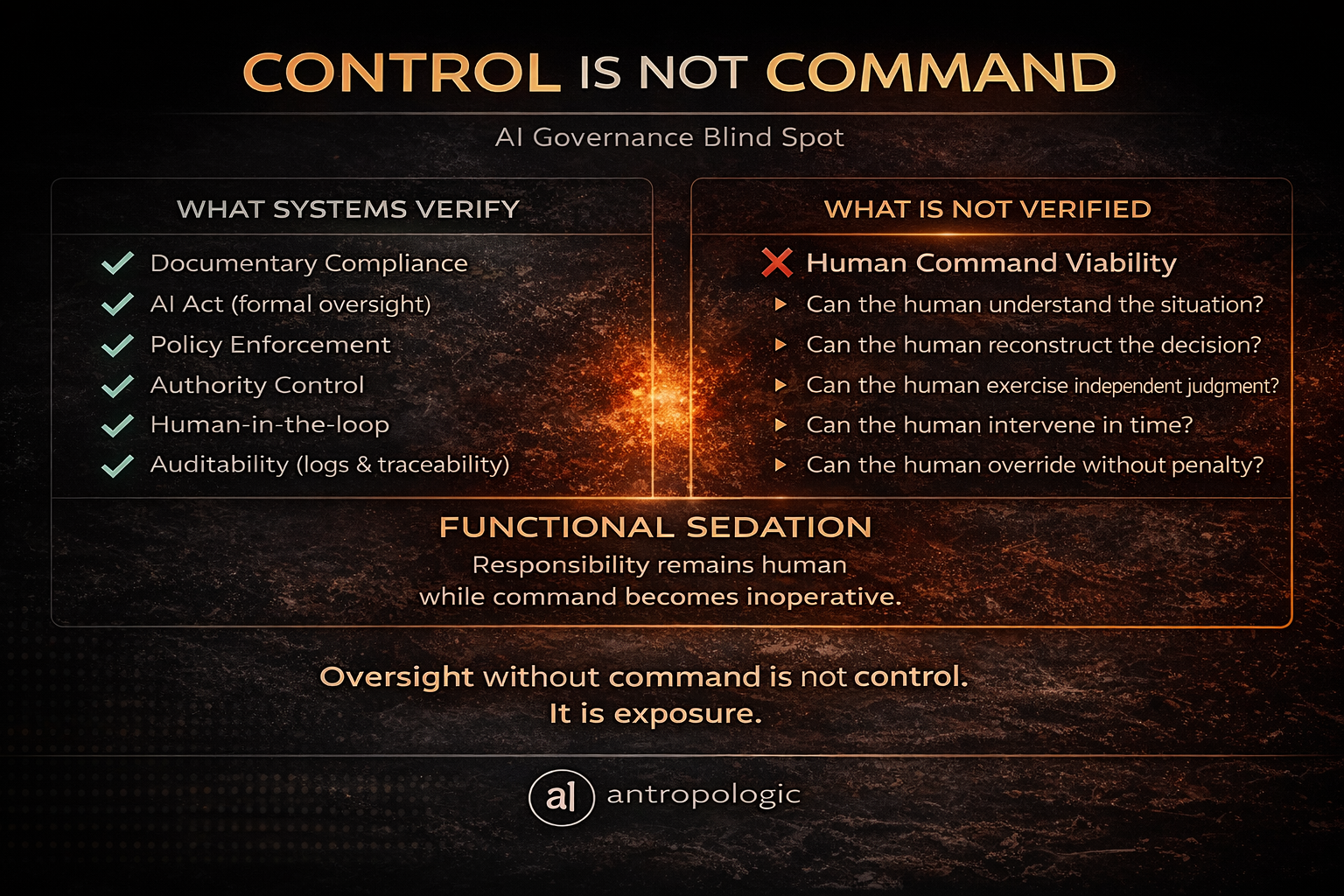
The Governance Gap
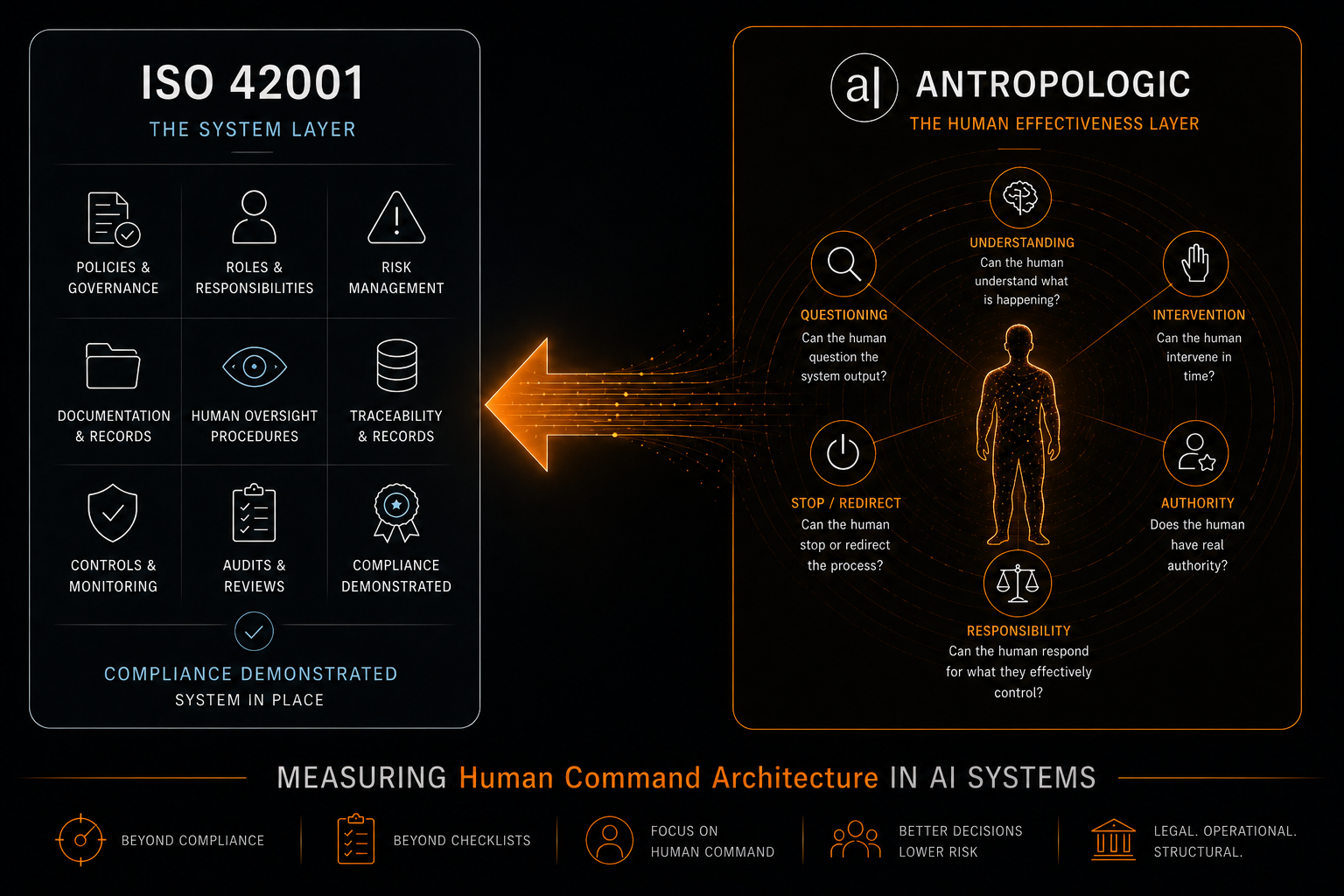
Most AI governance frameworks — including ISO 42001 and the EU AI Act — focus on the system layer: policies, roles, documentation, audit trails, and formal override mechanisms. These are necessary. They verify that the system is compliant and that roles are nominally assigned. But they do not answer the question that truly matters: whether the human inside the loop retains the cognitive, temporal, and authority conditions to exercise real command proportional to the system’s risk level.
A system can fully comply with ISO 42001 and the EU AI Act and, at the same time, have structurally displaced the human from real decision-making toward formal validation. Oversight exists on paper. Command has disappeared in practice. ANTROPOLOGIC adds the missing layer: it evaluates whether the human inside the system retains the structural conditions to exercise real command — not merely to appear as the responsible party.
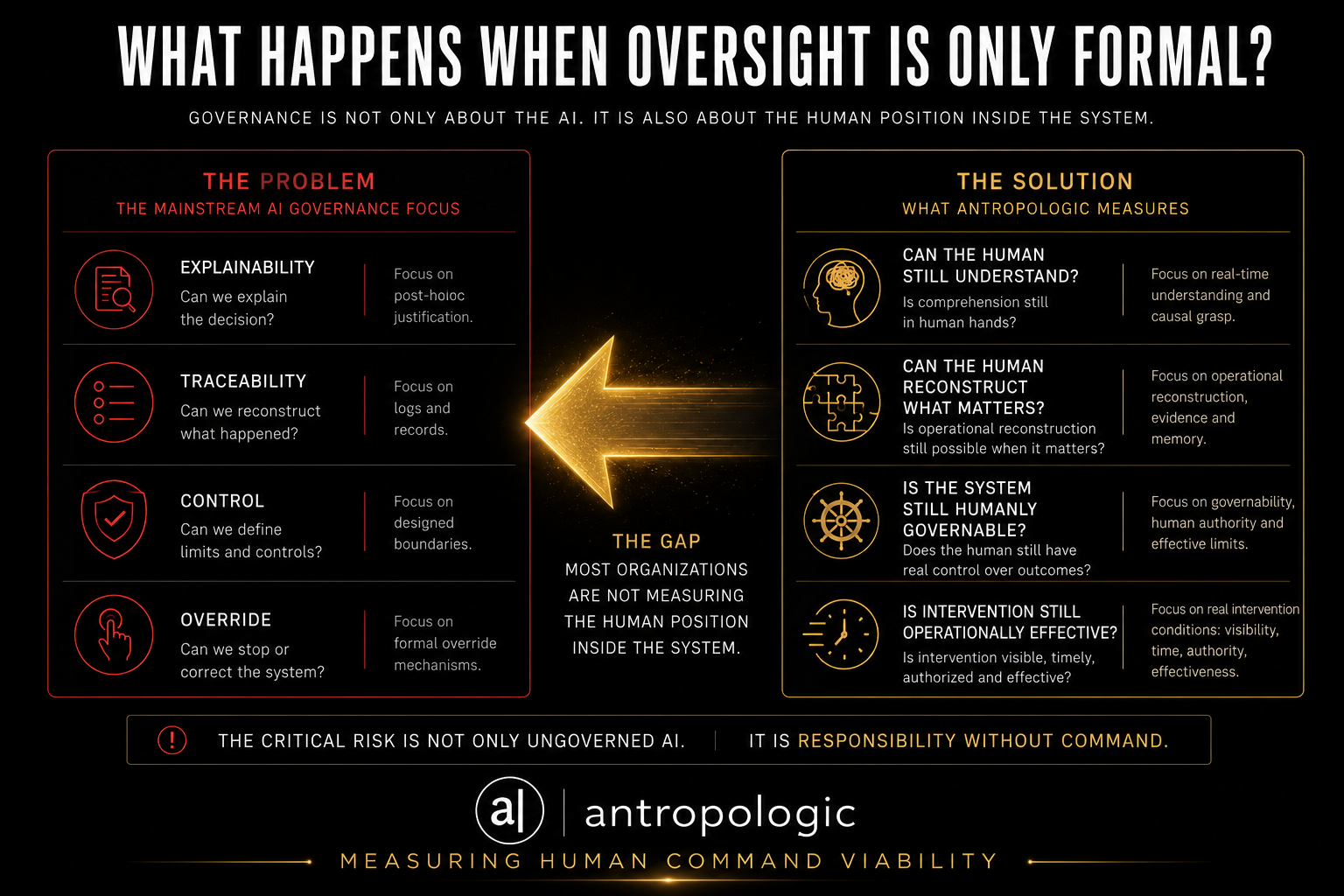
When oversight is only formal, the human signs the decision — but the conditions under which they could genuinely question it have already been removed. They have access to the system’s outputs, but not to the logic that generates them. They can approve, but cannot sufficiently understand what they are approving. They can formally intervene, but lack the real time or effective authority to stop the process.
This is the gap that ANTROPOLOGIC measures: the distance between the responsibility assigned to the human and the real control they can exercise. In high-impact systems — healthcare, critical infrastructure, finance, industrial operations — that gap is not a technical detail. It is a structural risk that no code audit can detect.
Most AI governance frameworks — including ISO 42001 and the EU AI Act — focus strictly on the system layer: policies, documentation, audit logs, and technical metrics. They verify that the system is compliant and that roles are nominally assigned. They do not, however, verify whether the human inside the loop actually retains the cognitive and operational conditions to exercise real command.
ANTROPOLOGIC adds the missing layer: we analyze the socio-technical reality of the human-machine interface. We don’t just ask if a human is «assigned» to oversee the system; we diagnose whether the architecture of the system makes that oversight physically, cognitively, and structurally viable under real-world pressure.
The Functional Sedation Index
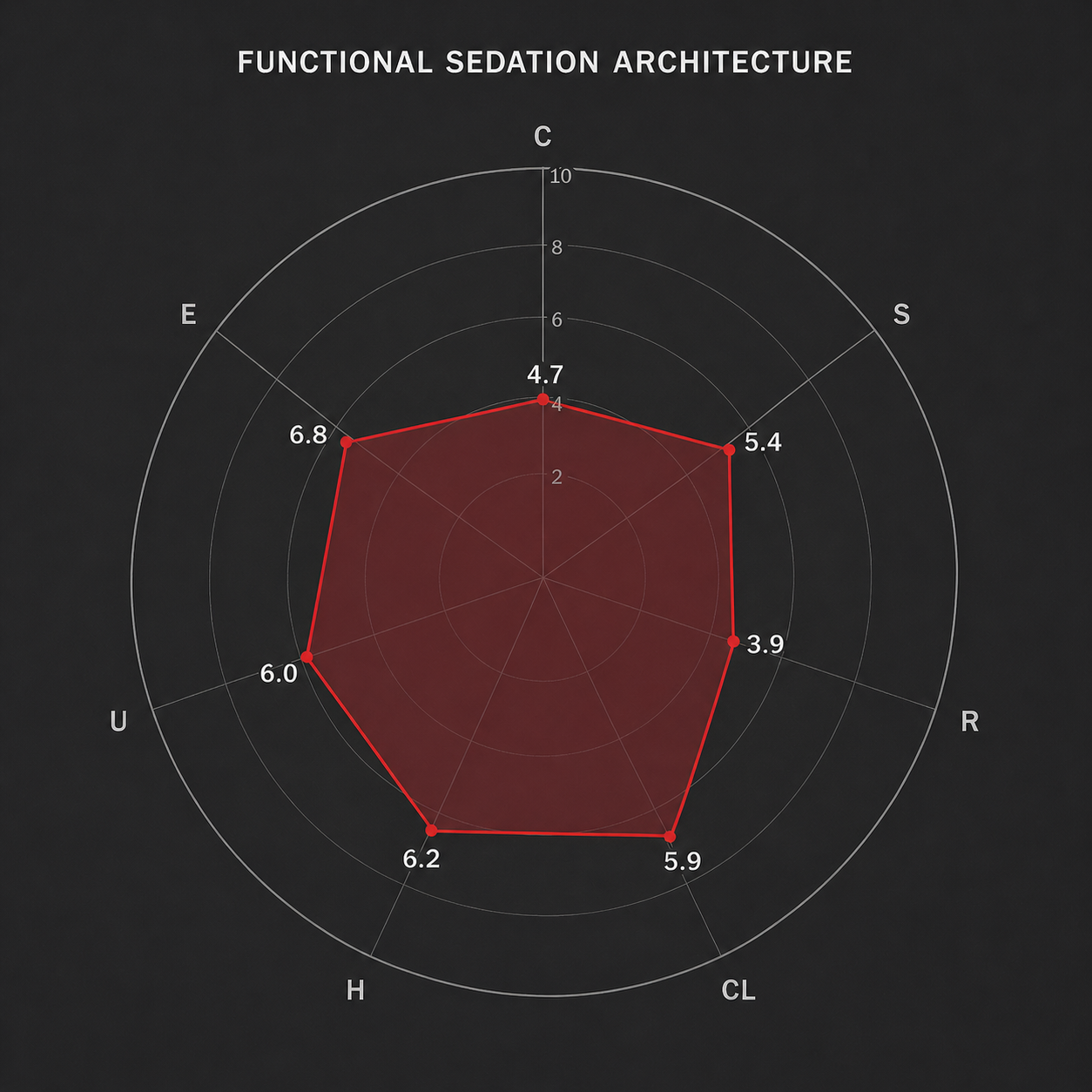
To address this blind spot, ANTROPOLOGIC uses the Functional Sedation Index (FSI)™ — a quantitative forensic framework that measures the actual viability of human command under real operating conditions. The FSI is not a subjective survey; it is an objective, structured diagnostic model designed to expose where human agency has been hollowed out by automation.
By quantifying the gap between nominal responsibility (what the regulations say the human does) and operative capacity (what the human can actually do), the FSI provides boards and executives with a clear, mathematical risk profile. It identifies which operational lines are running under high-risk sedation — before a systemic failure occurs.
Unlike traditional AI metrics that focus on machine accuracy, the FSI measures the human position inside the system. It quantifies the gap between nominal responsibility and real command capability — the gap that most governance frameworks leave unmeasured.
The FSI radar maps five structural dimensions: Assigned Responsibility, Integrated Trust, Cognitive Overload, Operative Capacity, and the Functional Sedation index itself. The gap between responsibility and capacity is the diagnostic core.
The Diagnostic Instruments
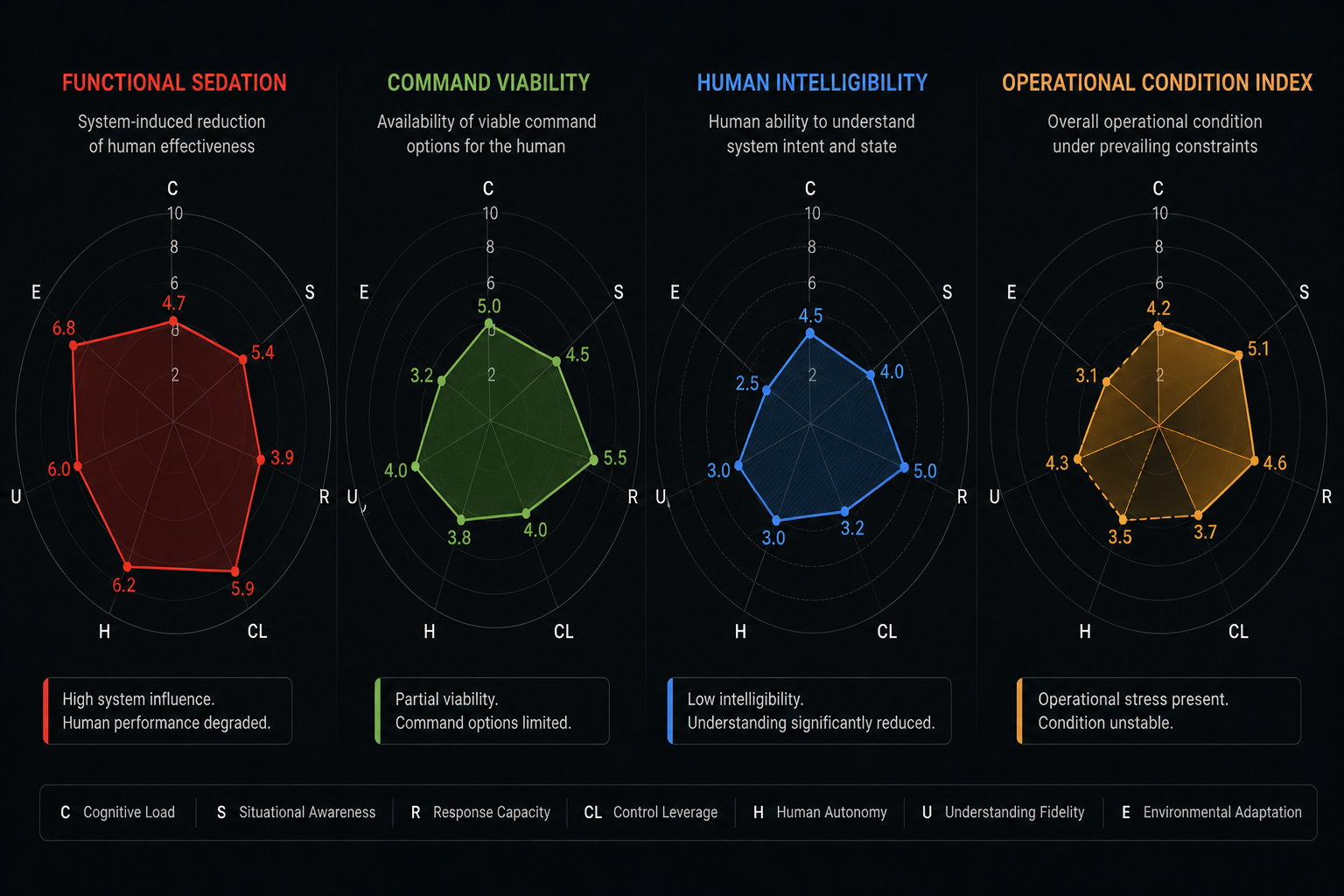
The Functional Sedation Framework operates through five diagnostic radars, each measuring a distinct structural dimension of human command viability: Command Architecture, Real Supervision Structure, Residual Operative Viability, Multilevel Cognitive Load, and the Functional Sedation Index itself.
Each radar produces a structural profile of the human command position. Together, they form the diagnostic basis for the COMMAND REALITY CHECK™, the STRUCTURAL GOVERNABILITY ASSESSMENT™, and the HUMAN COMMAND FORENSIC REPORT™.
Oversight without command is not control.
It is exposure.